
Solar Pv Calc
How big a solar system do you need? This calculator works from your annual electricity use and the average peak sun hours where you live, allows for real-world system losses, and tells you the system size in kilowatts, how many panels that means, the roof area they need, how much they would produce, and a rough cost and payback using prices you enter.
- Free to use
- No sign-up
- Runs in your browser
Solar PV system calculator
Solar Planning Pack
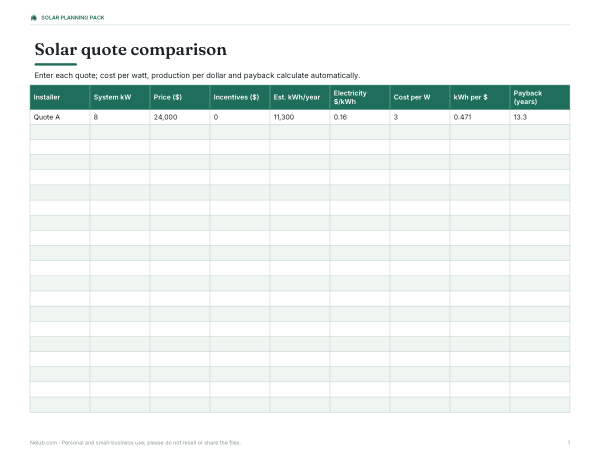
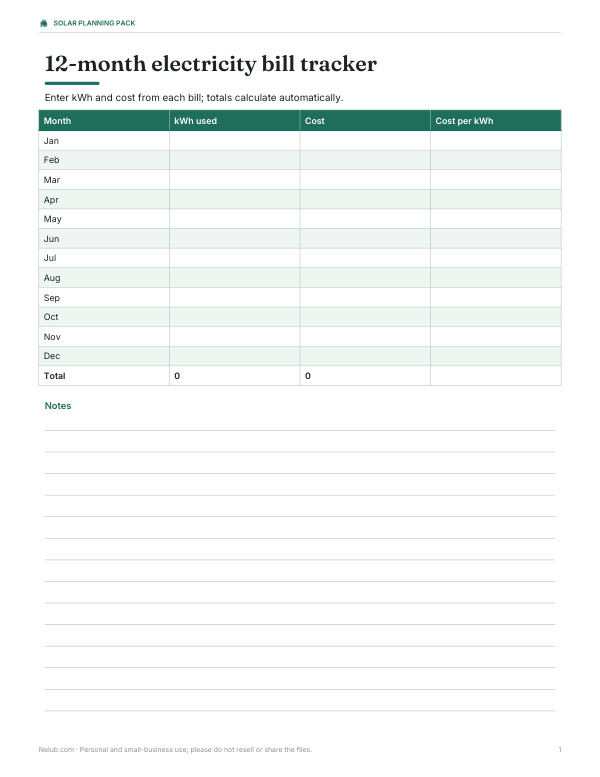
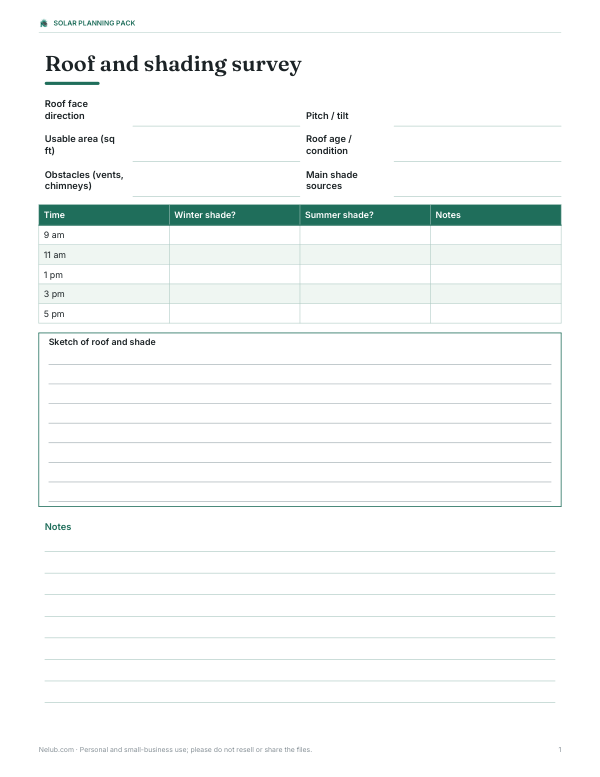
Excel solar quote comparison sheet (cost per watt, production per dollar, payback), a 12-month electricity bill tracker, a roof and shading survey sheet and an installer questions checklist.
- Quote comparison (XLSX)
- Bill tracker (XLSX)
- Roof survey (DOCX/PDF)
- Installer checklist (PDF/DOCX)
Formats: XLSX, PDF, DOCX. Instant download after payment (link valid 72 hours, up to 5 downloads). AI-assisted: the templates were drafted with AI help and reviewed and laid out before publishing.
$5.00 USD, one-time 4 files · about $1.25 each
- Instant download
- 7-day refund
- Secure checkout by Stripe
7-day money-back guarantee. Full refund within 7 days of purchase, even after you download.
Free sample: Electricity Bill Tracker (PDF, 62 KB)
Full refund within 7 days — see the refund policy and license.
Free printables
Single sheets you can print right now, no sign-up. The full pack adds every sheet in one download plus the editable files.
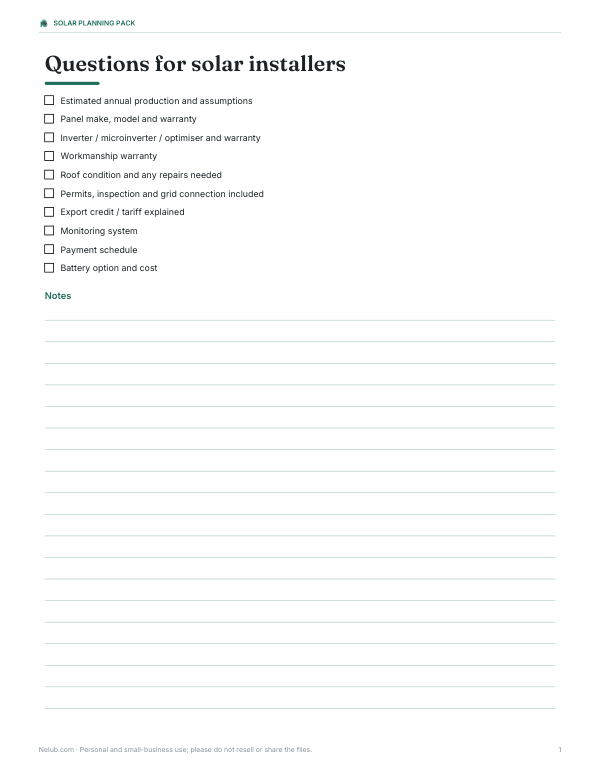 Printable Solar Installer Checklist
How the sizing works
- Add up a year of electricity use from your bills (or multiply a typical month by 12).
- Decide what share to cover — 100% aims to match your annual use.
- Find the average peak sun hours for your area: the equivalent number of hours per day of full-strength sunlight (1,000 W/m²).
- Each kilowatt of panels then produces about sun hours × 365 × (1 − losses) kWh a year.
- System size = the energy you want ÷ that figure.
- Panels = system size ÷ panel wattage, rounded up.
Worked example
| Step | Value |
|---|---|
| Use | 900 kWh/month = 10,800 kWh/year |
| Sun and losses | 4.5 h × 365 × 0.86 ≈ 1,413 kWh per kW per year |
| System size | 10,800 ÷ 1,413 ≈ 7.65 kW |
| Panels | 7.65 kW ÷ 400 W → 20 panels (8.0 kW) |
| Roof area | 20 × 21 sq ft ≈ 420 sq ft (39 m²) |
| Production | 8.0 × 1,413 ≈ 11,300 kWh/year |
| Cost at $3.00/W | $24,000 before incentives |
| Savings at $0.16/kWh | 10,800 kWh × $0.16 ≈ $1,728/year |
| Simple payback | about 13.9 years |
These are the calculator’s default inputs. Change them to your own bill, local sun hours, quotes and tariff.
Peak sun hours
Peak sun hours are not the same as daylight hours. A place with 12 hours of daylight might receive the same total energy as 4.5 hours of full-intensity sun. Sunny desert regions can average 6 or more; much of the central and eastern US and southern Europe are around 4–5; cloudier northern regions can be 2.5–3.5. National laboratories and solar agencies publish maps and calculators — for example, the US National Renewable Energy Laboratory’s PVWatts tool — that model your exact location, roof angle and direction.
System losses
| Loss | Typical cause |
|---|---|
| Inverter | Converting DC to AC |
| Temperature | Panels produce less when hot |
| Wiring | Resistance in cables |
| Soiling | Dust, pollen, snow |
| Shading | Trees, chimneys, neighbouring buildings |
| Mismatch and ageing | Small differences between panels; slow degradation over time |
A combined loss of around 14% is a common default in planning tools; shading can add a lot more. Panels also lose a little output each year — often around half a percent — which the simple estimate ignores.
Roof direction and tilt
- In the northern hemisphere, south-facing roofs produce the most; east and west roofs typically produce somewhat less over a year.
- A tilt close to your latitude maximises annual output, but most pitched roofs are close enough.
- North-facing roofs in the northern hemisphere (south-facing in the southern) produce much less.
- Avoid shade between mid-morning and mid-afternoon — even partial shading can cut output noticeably without optimisers or microinverters.
Cost and payback
Installed cost per watt varies widely by country, installer, system size and equipment, so use real quotes. Simple payback divides the net cost by yearly bill savings; it ignores financing, electricity price changes, panel degradation, maintenance and the value of exported power. Incentives, tax credits and export tariffs change frequently — check what applies in your area and year before relying on any figure.
Reducing use before sizing
Every kilowatt-hour you don’t use is one you don’t need panels for. Before sizing a system, look for easy efficiency gains: LED lighting, a smart thermostat, sealing draughts, or replacing an old fridge. If you plan to add an electric car or heat pump soon, include their expected use instead — an electric car driven 10,000 miles a year typically needs roughly 2,500–3,500 kWh, depending on the vehicle and driving.
Net metering and self-consumption
How much solar saves depends on how your electricity supplier credits power you export. Under full net metering, exported kilowatt-hours offset imported ones one-for-one, so covering 100% of annual use makes sense. Where exports earn less than you pay to import, it often pays to size the system closer to your daytime use and shift appliances such as dishwashers and car charging into sunny hours, or to add a battery.
Questions to ask installers
- What annual production do you estimate, and with what losses and shading assumptions?
- Which panels, inverter or microinverters, and what warranties?
- How will exported electricity be credited on my tariff?
- Does my roof need work before installation?
- What permits, inspections and grid connection steps are included?
- Would a battery make sense for my usage pattern?
Solar planning pack
The optional pack includes an Excel solar comparison sheet for up to five quotes (cost per watt, production per dollar, payback), a 12-month bill tracker, a roof and shading survey sheet and an installer questions checklist. The calculator above is free.
AI-assisted content
This page was drafted with AI assistance and reviewed before publishing. Results are estimates; they are not an engineering design or financial advice.
Frequently asked questions
How many solar panels do I need?
Divide the system size in watts by the panel wattage; e.g. 7.65 kW with 400 W panels needs 20 panels.
How do I calculate solar system size?
Annual kWh ÷ (peak sun hours × 365 × (1 − losses)).
What are peak sun hours?
The daily solar energy expressed as hours of full-strength sunlight.
How much roof space do solar panels need?
Roughly 17–22 sq ft per residential panel, plus spacing.
How long is solar payback?
It varies widely with cost, sun, incentives and electricity prices — often many years; enter your own numbers.
Does this include batteries?
No, it sizes the panels only.
How much electricity does a 1 kW solar system produce?
About 1,100–1,800 kWh a year in many locations — roughly peak sun hours × 365 × 0.86.